
Article: Why biodiversity offset multipliers matter so much?
New BOOST article by Jalkanen et al., Defining ecologically realistic biodiversity offset multipliers with the response-based habitat hectare assessment of biodiversity gains (REHAB), explains the logic behind Finland’s offsetting system, including its metrics and multipliers, while also highlighting major shortcomings of the commonly used fixed multipliers.
Biodiversity offsetting can be hard because restoring lost or degraded nature is difficult. Offset multipliers, which define how large area needs to be offset in relation to the area lost, should therefore increase when the expected offset gains are smaller, time lags are longer, or the uncertainty associated with the actions is greater. Yet, most offset schemes use single or a few fixed offset multipliers for all offset types. We set out to analyze how much offset multipliers truly vary, if they are based on ecologically sound estimates of the gains delivered by different actions in different habitats. In our paper, we present the ”Response-based Habitat Hectare Assessment of Biodiversity Gains” (REHAB) framework, a practical approach to estimate ecologically realistic offset multiplier that was developed during the implementation of Finland’s biodiversity offsetting policy.
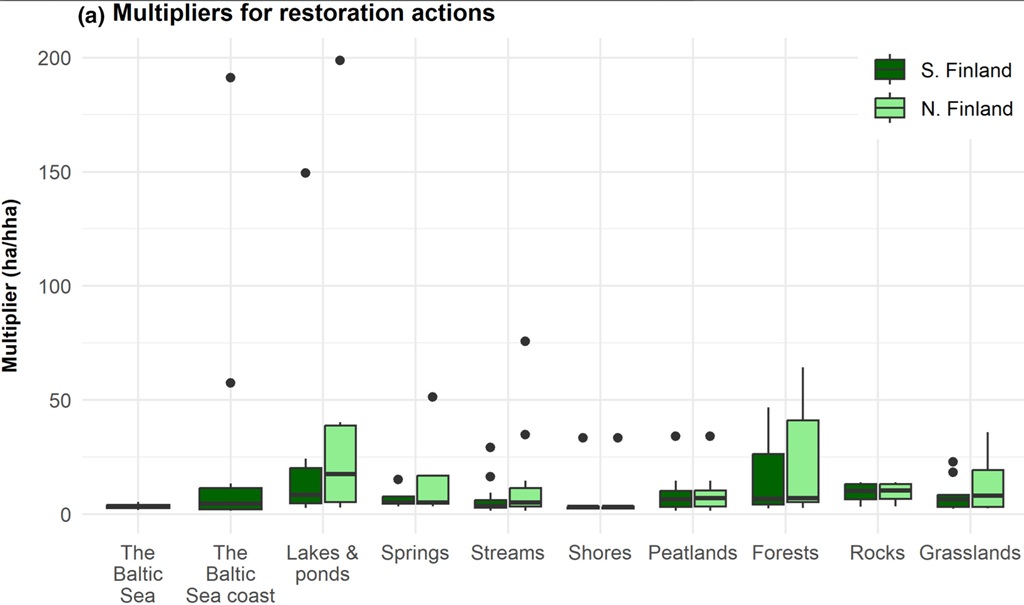
To develop the framework, we harnessed the knowledge of more than hundred experts to compile ecological attributes and condition matrices for all 388 Finnish habitat types and derive 346 offset action multipliers that represent ecological response functions for 216 habitat type-specific offset actions including restoration, management and passive recovery.
Our analysis shows that response-based offset multipliers vary enormously – from 1.3 to nearly 4,000 – highlighting how critical the choice of offset action really is! We find that the fixed multipliers commonly used in offset schemes would result in net biodiversity loss in 60% of the cases if action–habitat specific responses were not considered. This variability underscores that fixed multipliers cannot reliably deliver positive biodiversity outcomes and should therefore be avoided in offsetting schemes.
The REHAB framework paves the way for more ecologically sound biodiversity offsetting and offers a model for a measurable, verifiable, and ecologically realistic nature credit system. It brings transparency to offsetting and incentivizes the use of fast, certain, and effective actions as well as avoidance of biodiversity losses that are difficult, and expensive, to offset. The Finnish case also provides an example of a successful science-policy-implementation and collaboration process, described in detail in the article.
Link to press release (in Finnish): https://www.helsinki.fi/fi/uutiset/luonnonsuojelu/luontohaittaa-ei-voida-hyvittaa-yhdella-vakiokertoimella-tarvittavat-kompensaatiot-vaihtelevat-jopa-tuhatkertaisesti
Article by Joel Jalkanen, Eini Nieminen, Aapo Ahola, Emma Luoma, Minna Pekkonen, Panu Halme, Janne S. Kotiaho & Heini Kujala in Conservation Science and Practice: https://doi.org/10.1111/csp2.70355