
Recording: Evaluation of the Finnish biodiversity offsetting system by Sophus zu Ermgassen
As part of the reform of the Finnish Nature Conservation Act in 2023, a new chapter on voluntary biodiversity offsetting and its application in Finland was introduced. The Finnish policy framework has attracted international interest due to its high level of ambition in addressing many of the criticisms directed at offsetting systems worldwide. Now that the system has been established, it is important to assess how well it aligns with the general international principles of biodiversity offsetting and whether its metrics, rules and methods could be extended to emerging nature credit markets more broadly.
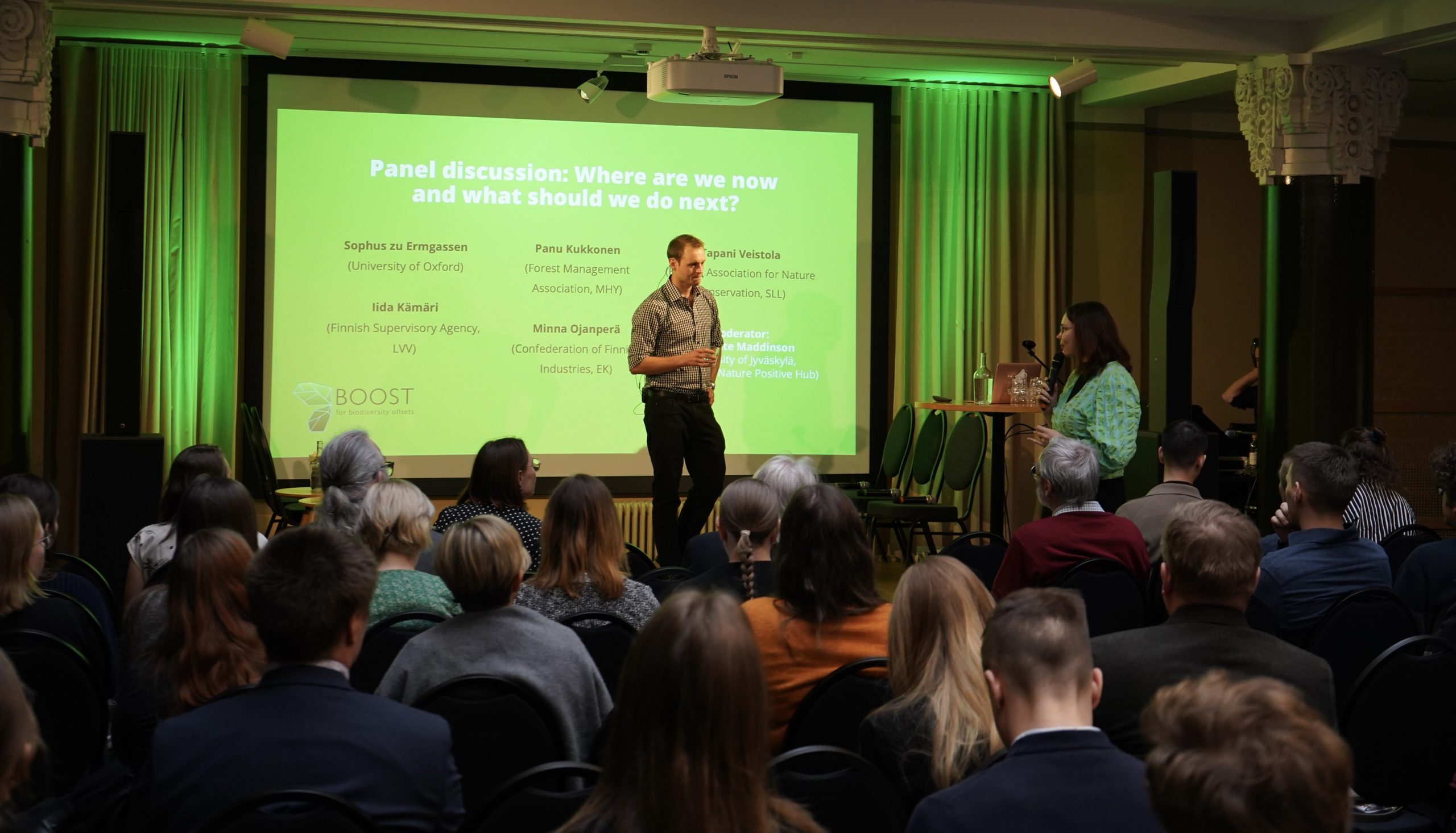
To provide an objective expert perspective, the Finnish Ministry of the Environment, together with the BOOST research consortium, invited Dr Sophus zu Ermgassen from the University of Oxford to conduct an ex-ante evaluation of the system. The results were presented at a public event on 18 March 2026 in Helsinki. The event also included an overview of the Finnish socio-legal framework and scientific basis, and concluded with a panel discussion on the current state of play.
- In his evaluation, zu Ermgassen was impressed by the depth of co-creation in the Finnish system. The level of effort put into this collaborative process, involving hundreds of experts, is exceptional and has contributed to a broader understanding of the system. This co-creation lays a strong foundation for its tools and acceptance.
- Another notable strength is the system’s emphasis on permanence of the offsets. According to zu Ermgassen’s view, the established rules in this regard are rare and represent a world-class standard. Indeed, the lack of permanence is a known weakness in some other international systems.
- At the same time, he identified lack of monitoring as a key risk. International experience shows that without robust monitoring, offsetting systems rarely deliver their intended outcomes. Monitoring is essential not only to prevent non-compliance but also to verify that the ecological outcomes develop as projected.
- As a market risk, zu Ermgassen noted that the Finnish system’s combination of high standards and a voluntary approach may limit demand for offsets. The simplest solution to this would be to move toward a mandatory system. Within a voluntary system, demand could also be increased, for example, requirements set by municipal governments requiring offsets, even in the absence of state law.
Overall, the evaluation provides strong support for the Finnish biodiversity offsetting system. It offers a valuable template for the development of nature credit markets in Finland and the EU.
Finland’s offset system represents in my view an internationally-leading effort to build an offset system in close collaboration with scientists and based on the best available science of how biodiversity responds following ecological restoration. It has several features that are best in class, including its calculation of offset multipliers, the degree of collaboration between science and policy, its long-term time horizon, and the commitment to transparency in its offset registry. It has serious potential as a system, but we’ll only know for sure once projects have been implemented and we’ve had the chance to monitor and check the compliance of the first generation of offsets. The scientific community will be watching how it develops with great interest.
– Sophus zu Ermgassen
Finally, while biodiversity offsetting and nature credit markets can play an important role in mobilising private sector funding to address biodiversity loss, nature conservation should not be fully outsourced. At the same time, it is crucial to ensure that increasing private investment does not lead to a reduction in public funding for biodiversity protection.
Program
9.00 Opening words (Emma Terämä, Ministry of the Environment)
9.10 Overview of the Finnish System
- Leila Suvantola (Ministry of the Environment)
- Heini Kujala (University of Helsinki)
- Paula Horne (Pellervo Economic Research, PTT)
10.00 Evaluation by Sophus zu Ermgassen (University of Oxford)
- General principles of the credit market from international perspective
- Pros and cons of the Finnish system in comparison
- Questions & answers
11.10 Panel discussion: Where are we now and what should we do next?
- Sophus zu Ermgassen (University of Oxford)
- Iida Kämäri (Finnish Supervisory Agency, LVV)
- Panu Kukkonen (Forest Management Association, MHY)
- Tapani Veistola (Finnish Association for Nature Conservation, SLL)
- Minna Ojanperä (Confederation of Finnish Industries, EK)
12.00 Closing the event
Host: Emma Luoma (Akordi)
Panel moderator: Charlotte Maddinson (University of Jyväskylä)
Presentation slides:
2026 Kujala
2026 Horne
2026 Suvantola
2026 zu Ermgassen
BOOST (2021-2027) – Biodiversity Offsetting as an Operational Tool for a Just Sustainability Transition Towards No Net Loss of Ecosystems and Biodiversity – facilitates the mainstreaming and enabling of a just transition toward the adoption of biodiversity offsets in Finland and globally. The research project is funded by the Strategic Research Council of Finland.
News updated 20.3.2026, 12:00